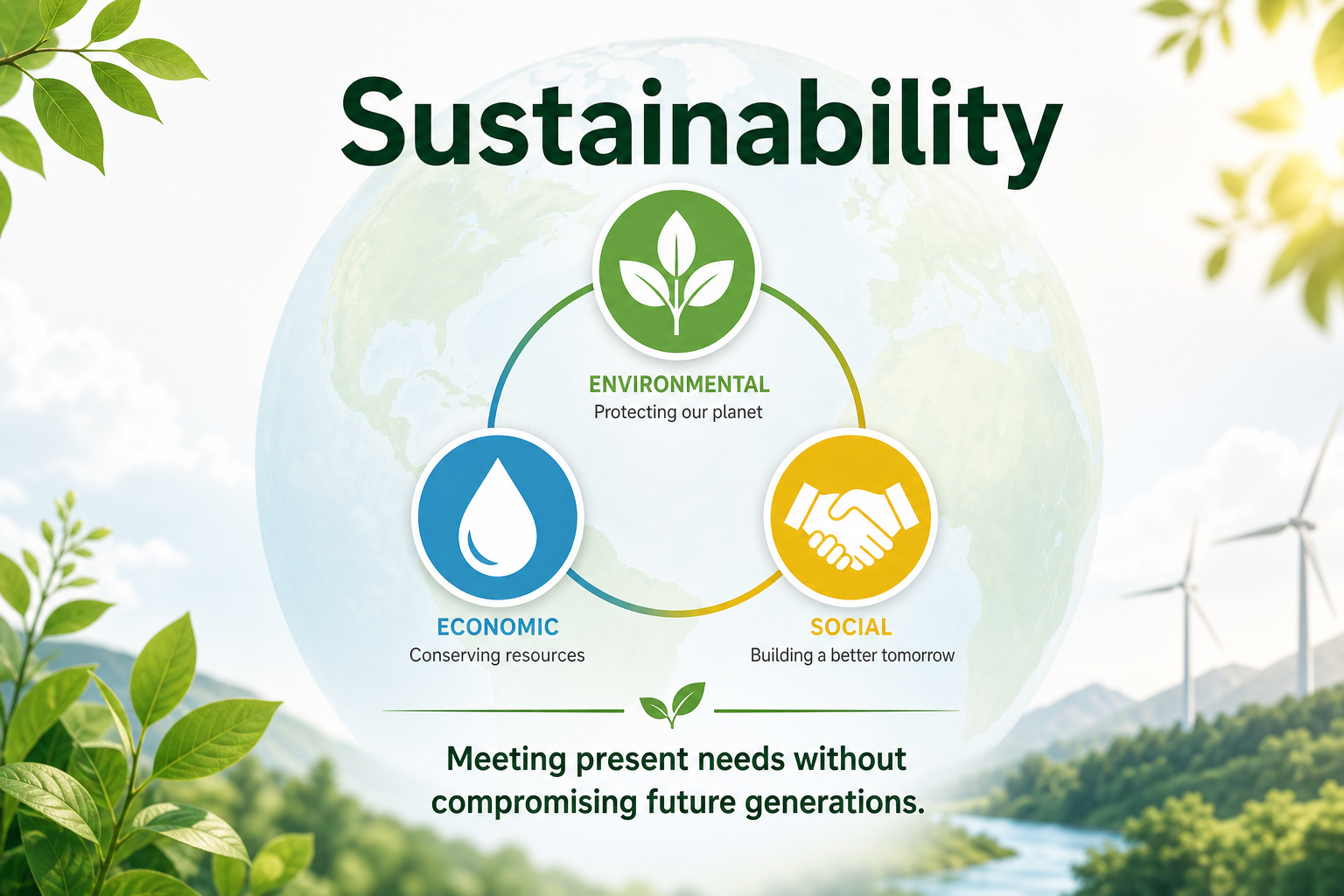
Sustainability - The pillars of a sustainable society
When we think about what makes a society truly successful, we often focus on what it can achieve today: its wealth, its comfort, or its progress. Yet history is full of communities that flourished for a time, only to fade because they took more than they gave, or neglected the things that kept them alive.
This is where sustainability becomes more than a modern concern; it is the quiet wisdom that asks us to look beyond our own lifetimes. It is the principle that reminds us a way of living is only truly good if it can be carried forward, renewed, and enjoyed by those who come after us.
Without it, even the most impressive achievements become temporary, leaving behind debt and damage for others to bear. To understand how we might build a society that is fair, strong, and enduring, we must explore what sustainability truly means, and why it matters so deeply.
To begin with clarity: sustainability is not simply about protecting nature, though that is vital. Nor is it about refusing to grow or improve, or restricting ourselves unnecessarily. This is a common misunderstanding: the idea that it asks us to give up what we value. In reality, it is something far deeper and more balanced.
It is not about standing still, but about moving forward without closing the door behind us. True sustainability is the practice of living so that we meet our own needs without compromising the ability of future generations to meet theirs.
It means recognising that we are temporary guardians, not owners, of the world and its resources. It balances care for the earth with care for people, ensuring both can thrive over time. It is rooted in respect: respect for the world that supports us, respect for one another, and respect for those who have not yet been born.
At its heart, sustainability is an expression of our shared humanity. It recognises that we are part of a long chain: we have received much from those before us, and we have a duty to pass on something of worth. Where it is absent, we see resources depleted, systems overstretched, and inequality grow between generations. By contrast, when it is embraced, it transforms how we think and act.
It encourages us to look further ahead, to value quality over quantity, and to understand that true prosperity is measured by how well we care for what we have, not just how much we consume. It builds justice, as it reminds us that no group or generation has the right to take more than its fair share.
Yet sustainability is never something that can be achieved once and forgotten. It is an ongoing way of living, calling us to look beyond our own convenience and make choices that serve the common good. It asks those with influence to lead by example, ensuring that care is shared fairly rather than being placed only on the vulnerable. It is a daily practice of respect, care, and gratitude.
When we look at what it takes to build a society that lasts, we see that sustainability is not an optional extra. It is the very heartbeat of responsible living together. It reminds us that we are guardians, not owners, and that our greatest legacy is not what we take, but what we leave behind. It is a vision that allows us to live well today, while keeping the world rich and full of hope for all who follow.
Post a comment