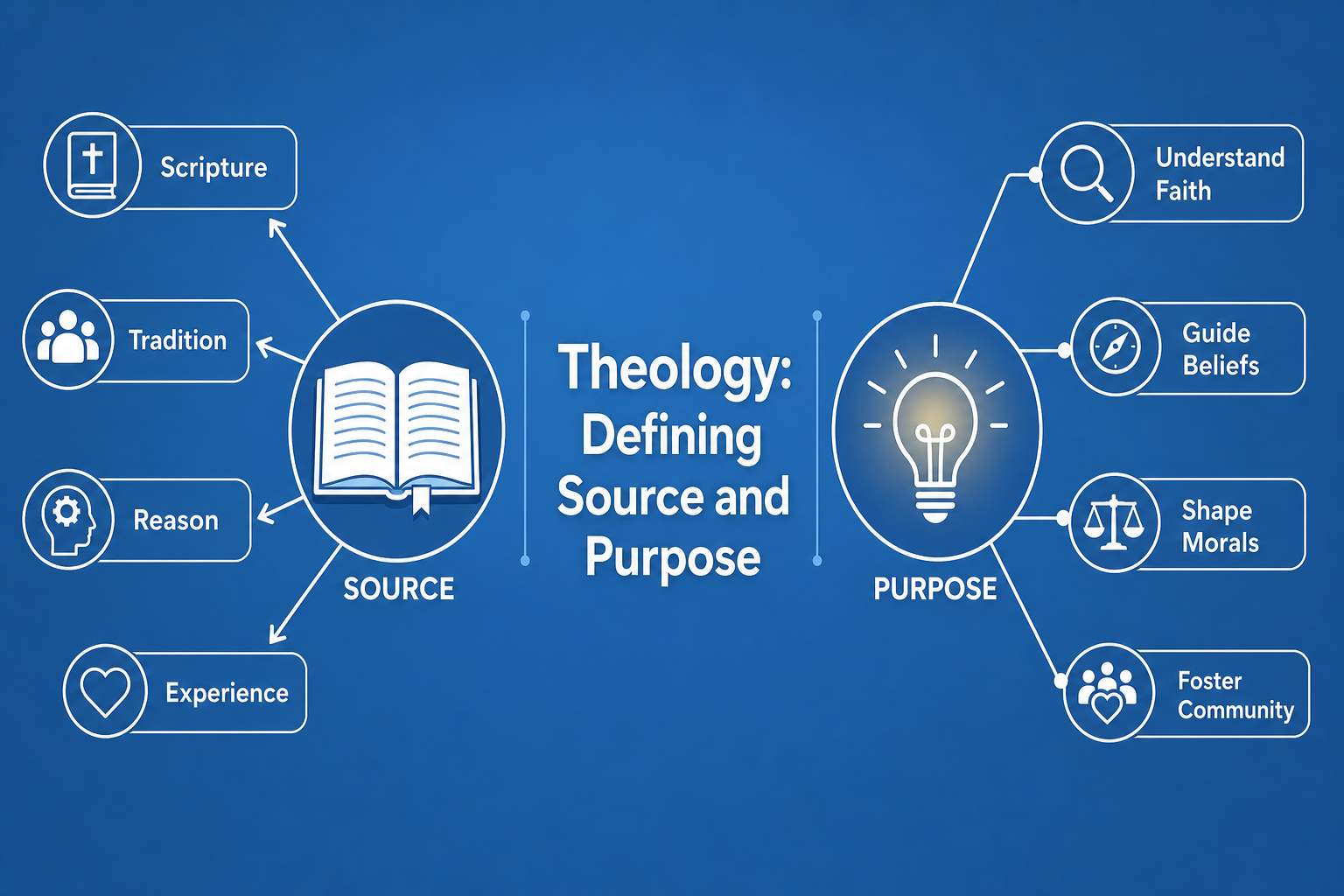
Why Theology? Defining “Source” and “Purpose”
In an age often dominated by data, utility, and measurable results, it is common to ask: What is theology actually for? Is it merely ancient tradition, abstract debate, or a set of private beliefs with no real bearing on public life? Many treat it as something separate from the serious work of understanding the world, or as a subject only for specialists
Yet when we look closely, theology addresses the two questions that every human being eventually faces, whether they realise it or not: Where do we come from? and What are we here for? To ask about Source and Purpose is to ask about the very foundation of existence. This reflection explores why theology matters, how it defines these two central ideas, and how understanding them shapes not only our faith but also our ethics, our communities, and the way we live together.
What Is Theology?
First, let us be clear: theology is not simply “religious opinion” or a list of rules. Literally, it means “thinking and speaking about God” but more fully, it is the disciplined, reasoned reflection on ultimate reality, meaning, and the relationship between the Creator and creation. It brings together scripture, tradition, reason, and experience to seek coherence and truth. It does not reject other forms of knowledge; rather, it asks the questions that other disciplines cannot answer:
Why is there something rather than nothing? What does it mean to be human? What is the good we are called to pursue? At its best, theology is not closed or defensive; it is an open inquiry that seeks to understand both the nature of the Source from which all things come and the Purpose toward which all things move. Without this framework, we are left with fragments of knowledge we know how things work, but not why they exist.
Defining “Source”: The Origin of All Things
To speak of Source is to address the question of origin. Where does the universe come from? Where does life come from? Where does goodness, beauty, truth, and dignity come from? Theological thinking particularly within the Anglican and Christian tradition understands Source not as a distant force, a random accident, or a material process alone, but as God: the eternal, self‑existent Creator, the ground and origin of all that is. As the opening of Genesis declares, “In the beginning God created the heavens and the earth”, and as the Gospel of John adds, “Through him all things were made; without him nothing was made that has been made.
This is not merely a historical claim; it is a statement about nature and relationship. If God is the Source, then everything that exists matter, life, humanity, order, and possibility finds its origin, its being, and its inherent value in the Creator. This changes everything: It means existence is not meaningless or accidental; it is intended. It means every person carries dignity not because of status, wealth, or ability, but because we come from the same Source.
It means the world is not neutral or hostile, but a creation given to us, with its own order, limits, and goodness. Crucially, the Source is also understood as personal: love, intelligence, freedom, and relationship are not late developing accidents, but reflect the nature of the One who made all things. To deny or ignore the Source is to cut the roots from the tree; we may still enjoy the fruit for a time, but eventually it will wither.
Defining “Purpose”: The Direction of All Things
If Source answers where we come from, Purpose answers what we are for. It is the question of direction, end, and calling. Theology teaches that purpose is not something we invent for ourselves alone, nor something assigned by society or culture. Rather, it is written into our nature by the Source who made us. The biblical witness describes this purpose clearly: To know, love, and serve God the Creator and Source
To live in right relationship with one another and with the created order. To grow in goodness, justice, and truth, reflecting the character of the Creator. To work toward the flourishing of all creation, participating in God’s plan of renewal and restoration. Purpose is not static; it is active. It means we are not simply consumers or survivors, but stewards and image bearers. As the Anglican tradition summarises in the Catechism, the chief end of humanity is “to glorify God and enjoy him forever” a statement that unites our highest calling with our deepest fulfilment. When we lose sight of this shared purpose, life becomes fragmented
We replace objective meaning with temporary desires, and our goals become self‑centred: power, comfort, status, or pleasure. Without a common purpose rooted in the Source, communities divide, justice becomes negotiable, and dignity becomes conditional. Purpose gives us a horizon beyond ourselves; it tells us that our lives matter, that our choices have weight, and that there is a standard of good greater than our own preference.
Why This Matters For Faith And Society
Some ask: Why does it matter if we define Source and Purpose theologically? Can we not build a good society without it? The answer lies in consistency. If we have no agreed Source, then human dignity is just an opinion it can be granted or taken away by those in power. If we have no agreed Purpose, then justice, equality, and the common good become matters of convenience, not obligation
Theology provides the only coherent foundation for values that are universal, lasting, and binding: From Source: We derive equal dignity, unity, and the sanctity of life. From Purpose: We derive the call to justice, stewardship, responsibility, and mutual care. This is why theology is not just a private matter. It shapes how we treat the poor, how we govern, how we care for the planet, and how we understand freedom. It tells us that freedom is not the right to do whatever we want, but the ability to do what we were created for to live in harmony with our Source and our Purpose.
Theology matters because it asks the questions that make sense of all other questions. By defining Source, it gives us a secure foundation: all life comes from God, bears God’s imprint, and belongs to God. By defining Purpose, it gives us a clear direction: we are called to reflect God’s goodness, to love, to serve, and to work for the flourishing of all creation
Without this understanding, we may have knowledge, but no wisdom; we may have activity, but no meaning; we may have laws, but no enduring justice. With it, we see ourselves not as isolated beings, but as part of a great story created from love, called to love, and destined for the fullness of life in God. This is why theology is never irrelevant. It is the framework that connects our origins to our destiny, and in doing so, it gives us the only solid ground on which to build both our lives and our communities.
Post a comment