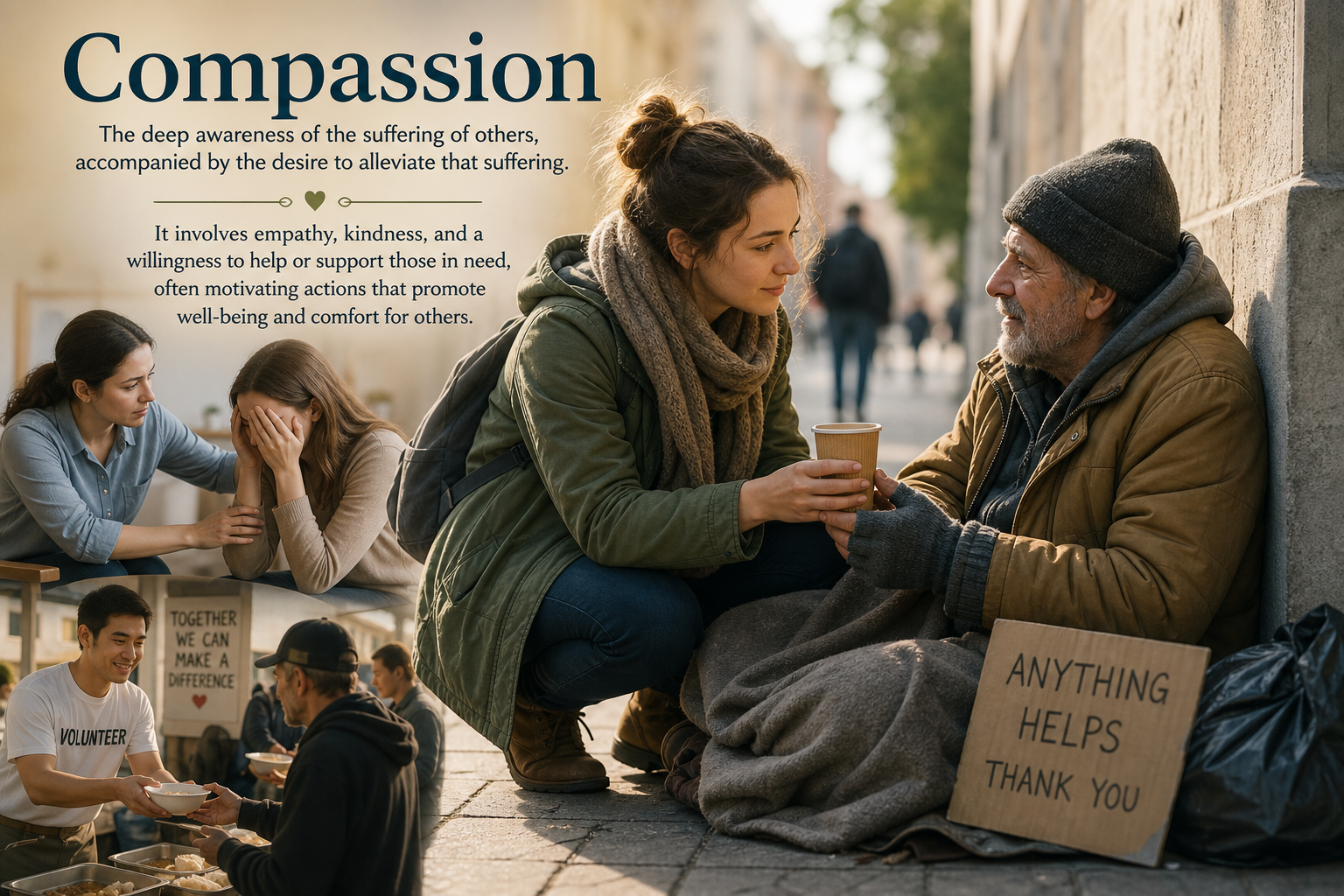
Compassion: The Living Heart Of A Sustainable Society
We often build our understanding of society around structures, laws, resources, and systems. These things provide the necessary framework, but a framework without a living heart soon becomes cold and rigid. It can stand upright for a time, but it will never truly nurture the people within it, nor adapt well to the changing needs of life
This is where compassion finds its place; it is not merely a personal virtue or a soft emotion, but a vital force that gives life and warmth to every part of our shared existence. It ensures our systems serve people, rather than people serving systems. Without it, even the most carefully ordered society can become harsh, divided, and ultimately unsustainable. To understand what it means to live together well, we must explore what compassion truly is, and why it matters so deeply.
To begin with clarity: compassion is not simply feeling sorry for someone, nor is it a weakness that sets aside fairness or responsibility. This is a common misunderstanding; some believe it means overlooking harm or rewarding laziness. In truth, it is far stronger and more balanced. It does not ask us to abandon standards, but to approach them with understanding and humanity
True compassion is the ability to recognise struggle or need in another, and to be moved to respond with care and respect. It is built upon empathy: the willingness to imagine oneself in another’s place, to see beyond outward appearances, and to acknowledge that every person carries burdens and hopes. It does not look down from above, but reaches out from shared understanding. It includes kindness, but also courage; it speaks up for those who are unheard, and works to remove the causes of hardship rather than only treating its effects.
At its heart, compassion is an expression of our shared humanity. It recognises that none of us is entirely self‑sufficient, and that the line between security and struggle is often thin. Where it is absent, trust fades, division grows, and people look out only for themselves. By contrast, when compassion is woven into community life, it creates an atmosphere of belonging
It changes how we make decisions, encouraging us to ask what is kind and fair, not only what is convenient. It ensures justice does not become mechanical, but takes account of different challenges and needs. It builds resilience, because when people know they will be treated with care, they are more willing to contribute and work together. It also ensures no‑one is discarded, and that human potential is nurtured rather than wasted.
Yet compassion is never only a feeling; it must be lived out in action. It requires us to listen before judging, to look beyond our own interests, and to remember that every person has a story we may not know. It calls upon those with influence to use their position to lift others up, and to shape systems that serve everyone fairly. It is a daily choice, shown in patience, respect, and willingness to help.
When we look at what it takes to build a society that endures, we see that compassion is far more than an optional extra. It is the living heart that gives meaning to every other principle. It reminds us that we are bound together, and that a society is only as strong as its care for all its members. It turns rules into relationships, and ensures that as we build for the future, we never lose sight of the truth that every person matters.
Post a comment