Cooperation: The Strength That Builds A Sustainable Society
We often speak of progress as if it depends entirely on individual effort, talent, or ambition. Yet if we look closely at anything that has truly lasted from a thriving community to a system that serves everyone fairly, we find something different at its core.
No person, and no generation, has ever built something of lasting value entirely on their own. Cooperation is not merely a helpful habit; it is the very mechanism through which human beings turn small, limited abilities into something strong, resilient, and capable of enduring across time. Without it, even the most brilliant ideas or abundant resources can become scattered, wasted, or used only for the benefit of a few. To understand how we might build a society that is fair, strong, and able to adapt, we must explore what cooperation truly is, and why it matters so deeply.
Cooperation is not the same as uniformity, nor does it mean giving up one’s own will or identity to fit in. This is a common misunderstanding: the belief that working together requires us to become identical or surrender our own judgement. In truth, it is far richer and more respectful. It does not demand that we set aside our uniqueness, but that we bring our different gifts and perspectives into a shared effort.
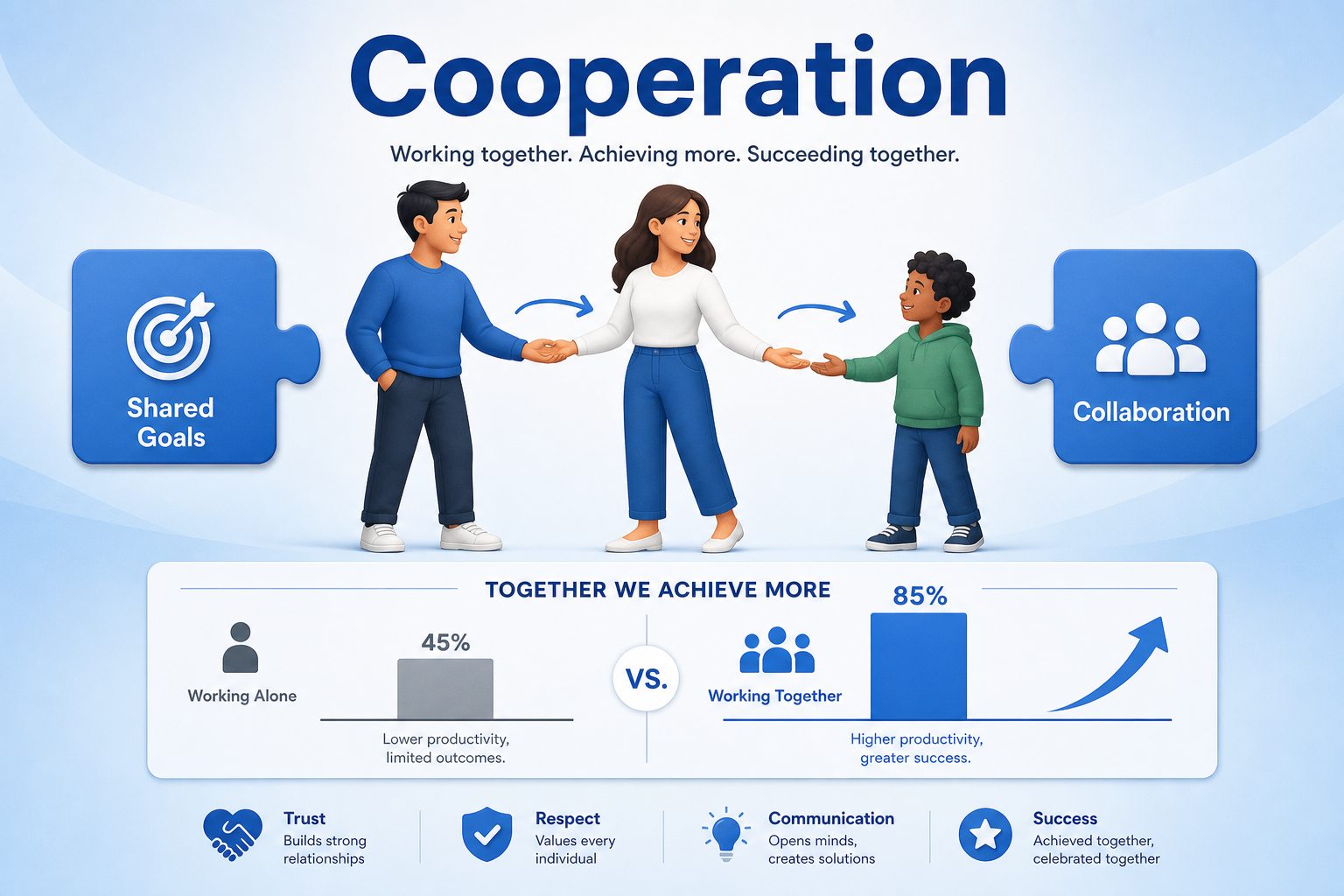
True cooperation is the voluntary coming together of people to work toward a common goal, recognising that what can be achieved together is far greater than what any could achieve alone. It is rooted in mutual respect and trust; it acknowledges that we all have limits, that we all have something to contribute, and that we need one another to meet our most important needs. It is not about being forced to act as one, but about choosing to act together because we understand our wellbeing is linked.
At its heart, cooperation is an expression of our shared humanity. It reflects the truth that we do not flourish in isolation, and that even the most self‑sufficient among us rely on others in countless ways. Where cooperation is absent, people see one another as rivals, trust erodes, resources are hoarded, and communities become fragile. By contrast, when it is valued, it multiplies our strength, allowing us to overcome challenges no individual could face alone. It creates a sense of belonging and ownership, as people are more willing to care for what they have helped build. It builds fairness and resilience, reminding us that success does not require someone else’s loss, and that shared prosperity is far more stable.
Yet cooperation is never automatic; it is a positive choice and a learned habit. It requires us to look beyond our own immediate wants, to listen to others, and to value different perspectives. It calls upon those with influence to bring people together rather than dominate, ensuring that everyone has a voice and benefits fairly. It is shown in small, daily acts of sharing, helping, and respecting what we hold in common.
When we look at what it takes to build a society that endures, we see that cooperation is far more than a practical convenience. It is the very foundation upon which all other good things rest. It reminds us that we are stronger together than apart, and that the greatest achievements are those that are shared. It turns individual effort into collective strength, creating a way of living that is stable, fair, and full of hope for the future.
Post a comment