Equity: The Framework Of Fairness, Inclusion, And Sustainable Society
When I listen to people speaking of what they hope for their communities and their children, I often hear the same desire expressed in different ways: a world where everyone has a genuine chance to thrive, where effort and ability matter more than circumstance, and where no one is held back by barriers they did not choose. Yet I have also noticed that this hope is often confused with other ideas, and that without clear understanding, good intentions can fail to bring real change
Equity is one of those concepts that is frequently misunderstood, even by those who support its goals. It is not merely another word for equality, nor is it about giving preferential treatment without reason. Instead, it is the practical application of fairness, designed to ensure that every person can stand on equal footing and contribute fully to the common life. For a society to remain balanced, resilient, and capable of sustaining itself across generations, equity must be woven into its thinking, its systems, and its daily habits. This reflection explores what equity truly means, how it differs from sameness or uniformity, why it is essential to long‑term well‑being, and how it can be lived out as a steady, life‑giving principle.
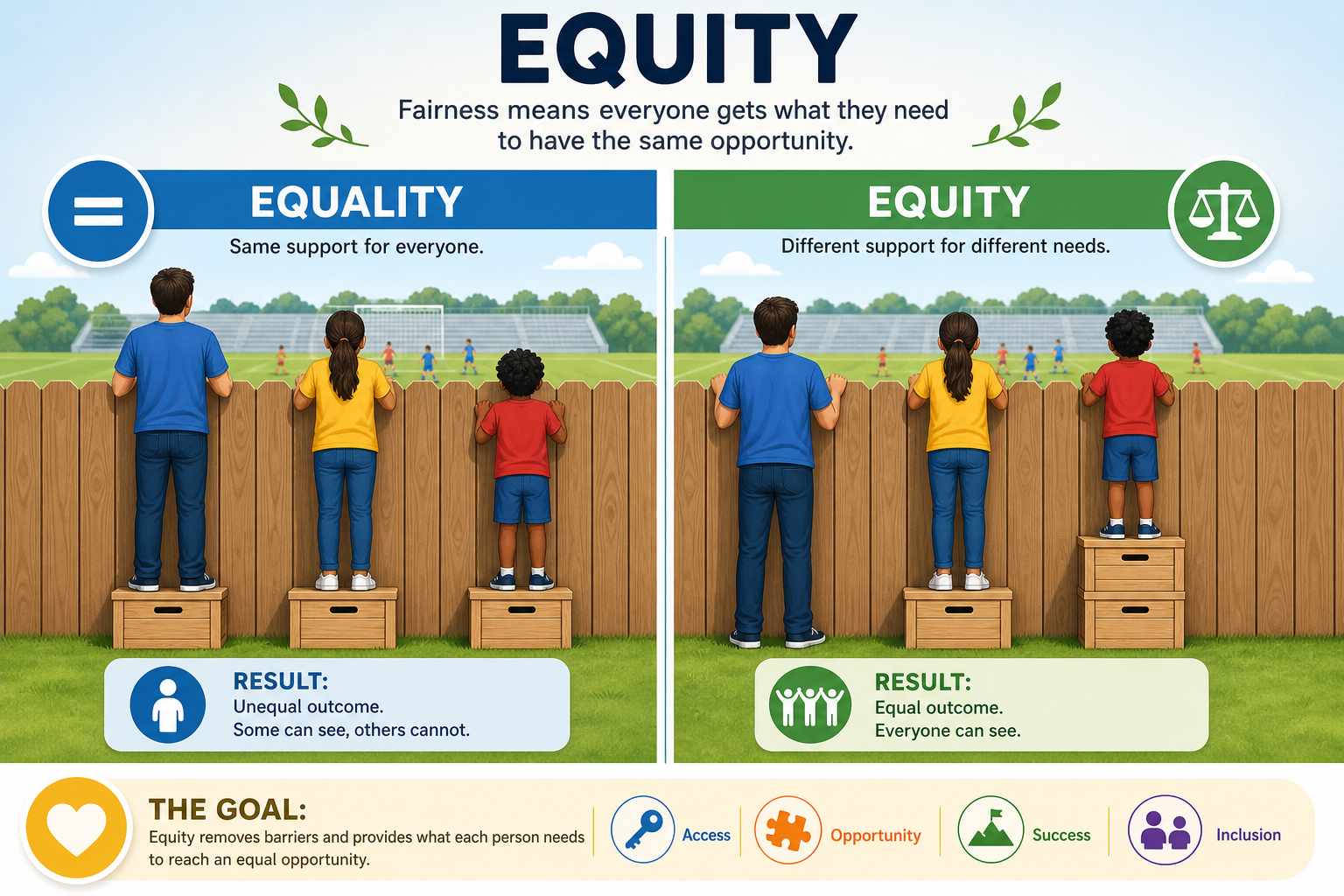
I have come to understand that much of the confusion surrounding equity arises from the common habit of treating it as identical to equality. While the two ideas are closely linked and share the same foundation of human dignity, they are not the same thing. Equality speaks to the equal worth and standing of every person, affirming that no one is more or less valuable than another. Equity goes a step further: it recognises that people start from different places, face different challenges, and have different needs, and it seeks to adjust conditions so that every person has the same opportunity to participate, grow, and succeed. It is often explained through the simple but powerful image of people trying to see over a wall: giving everyone the same‑sized box to stand on treats them equally, but giving taller boxes to those who are shorter or standing further back treats them equitably, ensuring that all can see clearly. This distinction is vital.
Equity does not mean giving more to some simply to reduce what others have, nor does it mean forcing everyone into the same shape or path. It means removing unfair barriers and providing what is necessary so that inherent dignity can be expressed in practice. It is also important to distinguish equity from favouritism or arbitrary redistribution. True equity is guided by consistent principles, not by personal preference or political advantage; it aims to correct imbalances, not create new ones. When we understand equity in this way, we see it as a way of making equality real rather than just theoretical. It is the bridge between what we believe about human worth and what we actually do to uphold it.
The role of equity in building a sustainable and flourishing society is both practical and profound. When equity is present, it acts as a stabilising and unifying force. It builds trust because people can see that the system is designed to give them a fair chance, rather than to protect the advantages of those who already have more. It unlocks potential, because when barriers are removed, the gifts, skills, and energy of every part of the community can be brought to bear on shared challenges. It fosters resilience, because a society that draws strength from all its members is far better equipped to adapt to change, weather difficulty, and plan for the future than one that relies only on a privileged few. Consider what happens when equity is absent or ignored.
Where conditions are designed only to treat everyone in exactly the same way without regard for differing needs, existing gaps and disadvantages widen over time. Those who already have resources, support, or advantage continue to move forward, while those who start behind find it ever harder to catch up. This leads to deepening division, where people feel that the rules work against them, and where the promise of a shared future begins to feel empty. Resentment grows, cooperation weakens, and the energy that could be used to build and sustain the community is instead spent on competition or survival. History shows us that societies marked by persistent imbalance and lack of equity eventually lose their cohesion; they cannot maintain broad‑based support, and their progress becomes fragile and unsustainable
By contrast, where equity is actively pursued, the benefits spread across every generation. Children from all backgrounds receive the support they need to learn and grow; workers are rewarded fairly and given equal opportunity to advance; and communities make decisions that serve the whole rather than just the powerful. In such an environment, people feel invested in the common good, because they know that their own well‑being is connected to that of their neighbours. Equity is therefore not a luxury or a burden; it is a practical necessity. A society cannot endure if it wastes the potential of half or more of its people, or if it allows gaps to grow so large that unity and trust are lost. True sustainability depends on inclusion, and inclusion depends on equity.
If equity is to become more than an idea or a policy statement, it must be lived out actively and consistently. It is not something that can be established once and left unchanged; it requires ongoing attention, reflection, and adjustment as circumstances shift. For individuals, living out equity begins with a shift in perspective. It means looking beyond surface appearances and recognising that not everyone faces the same obstacles or has access to the same support. It calls us to examine our own assumptions, to listen to the experiences of those whose lives are different from our own, and to ask whether our words and actions help create a level playing field or whether they unintentionally reinforce existing advantages. It means treating people with respect and seeking fair outcomes, even when it means adjusting our usual ways of doing things. For communities and institutions, equity means designing systems and practices that take account of real differences in need and circumstance. It means ensuring that access to education, healthcare, housing, employment, and public services is not limited by background, location, or wealth.
It requires regular review of laws, policies, and customs to identify hidden barriers and remove them, and to ensure that decisions are made with the full participation of all groups affected. I have found that equity and responsibility are deeply connected. To act equitably is to accept that we share a common home, and that the strength of that home depends on how well we enable every member to contribute
It asks those with greater privilege or power to exercise it with care and fairness, and to recognise that lifting others up does not diminish them, but strengthens the whole community. This is not a task for leaders alone, but a duty shared by all. When people understand that equity serves the long‑term good of everyone, they are more willing to support the changes and habits that keep it alive. This creates a society that remains balanced, adaptable, and capable of handing on to the next generation not only resources but also a way of life that is fair, inclusive, and hopeful.
As I reflect on what makes a society truly able to endure and flourish, I return again and again to the principle of equity. It is not about creating a perfect world where every outcome is identical, but about building a fair world where every person has a real and equal chance to live with dignity and purpose. It is the framework through which equality becomes visible and justice becomes practical. When we embrace equity, we affirm that every life matters, and that the well‑being of one is tied to the well‑being of all. Equity is not a threat to freedom or achievement; it is the foundation upon which true freedom and shared prosperity can stand
It ensures that our communities remain stable, inclusive, and capable of serving the needs of every generation, now and in the years to come. It calls us to look beyond our own immediate advantage and to invest in systems and relationships that bring balance and hope. In choosing to live out equity, we do not only build a better society for ourselves; we leave a legacy of fairness, inclusion, and lasting good for generations yet to come.
Post a comment